Category: Education
-

Quality of Education System in Fiji
So, we all know the picture-postcard version of Fiji. It’s all beautiful coasts and warm smiles. But if you peel back that layer, you’ll discover something as vital, but considerably less discussed: the classrooms. The sites where Fiji’s future is being shaped, one student at a time. Discussing the “quality” of the education system in Fiji can feel somewhat clinical. It’s not just about test scores or the number of computers in a lab. Here’s the thing about education in Fiji – it’s personal. It’s about a child in a rural village discovering the magic of reading. It’s a high school student in Suva studying late into the night, dreaming of university. It’s communities wrestling with how to honor generations of tradition while preparing their children for a global future. This isn’t some neat, textbook story. It’s complicated. It’s messy. But if you look closely, it’s also incredibly powerful. It makes one curious how schools actually work across hundreds of islands. Is it the same experience for everyone? As you would expect, the answer is a resounding nay. Fiji’s educational quality is a story of two realities: remarkable progress and obstinate obstacles. Let’s make an effort to understand what’s actually going on in those classes. -
Inside the Fiji School System
Step into the inner world of learning in Fijian land. In this blog, we will get up close and personal with the intriguing Fiji School System and its various characteristics and the lives of students and teachers who are part of it. In Fiji, people don’t only study to learn facts and numbers, education is the way to dreams, chances and brighter things, The education system in Fiji indeed is a value-adding centre in transforming the young lives of Fijians, equipping them with the knowledge and competences to excel in life. Learning in Fiji – from the crowded classrooms of primary schools to the vibrant university campuses is a cultural, diverse and community-driven fabric with values and traditions intrinsic to the Fijian people. Throughout this exposition we will discuss the history of education in Fiji, unraveling the structure of the education system, and exploring the problems and success achieved by students and educators. We shall also emphasise the strategies the Fijian government has developed to ensure that education is not a preserve of the rich alone. Therefore, pull your backpack and let’s get moving on a reweaving experience in the Fiji School System. Whether you are a student, a parent or generally an inquirer on the educational system of Fiji, this discovery is unveiling and educational.Historical overview of education in Fiji
To know the education system in Fiji today requires us to spare a glance at its historical sources. The education system of Fiji has a complex and dynamic background, marked by the colonial impact, local customs, as well as dreams of the island’s residents. Colonialism was introduced to Fiji in the late 19th century, during British rule when formal schooling was brought to the archipelago. This was the birth of a new era in education for the villages as schools started to sprout across the islands being built to serve Fijian kids. Nevertheless, access to education was restricted, therefore the children, especially the ones in rural and remote areas, were unable to go to school. Nevertheless, these problems did not stop education from gradually gaining a foothold in Fiji, with more schools opened to enthusiastic students. Fiji’s school system in the course of changing times reflected the ever-evolving orientation of the society and the changing aspirations of its people. In addition to traditional education, an effort was made to provide students with subjects such as mathematics, English and social studies which made the learning worthwhile. Although some progress has been made, Fiji school system has gone through several difficulties such as inequalities in access, limited resources, and cultural obstacles. Nevertheless, education was not low on their priority list as evidenced by the Fijian people’s resilience and determination to improve accessibility and quality. Education in Fiji is progressing today; it is constantly growing, driven by the determination to give every child the chance to study and develop his or her potential. It serves as a foundation of Fijian society, be it in schools in rural villages or universities in vibrant cities, offering individuals the confidence and knowledge needed to build our country.The structure of education
The Fiji school system is arranged into different levels of learning, each with the distinct objectives of achieving the educational process of Fijians. To comprehend how the education system in Fiji operates, one must take into account the system architecture.Primary Education:
- Primary education is the backbone of the Fiji educational system. It is obligatory to attend school, and children go through the first stage of education at the age of 6 and graduate at the age of 14.
- In primary school, students are taught the main subjects of mathematics, English, social studies and science among others. They also engage in activities or subjects such as music, physical education, and fine arts.
- The State makes primary education free and compulsory for all school-age children in Fiji.
Secondary Education:
- Secondary education is a continuation and advancement of what has been created at the primary level and sometimes leads to higher learning or entry into the job market.
- The last four years of Secondary education in Fiji normally lasts through Grade 9 to Grade 12. Students learn subjects from all corners like mathematics, English and languages such as Fijian and Hindi, technical subjects and humanities.
Tertiary Education:
- The tertiary level of education takes place at universities and other institutions of higher learning in Fiji.
- The main national public university in Fiji is the Fiji National University which provides programmes in fields such as medicine, business, agriculture, culture and technology.
- Other tertiary institutions such as the University of the South Pacific and the University of Fiji are offered, each with its particular modes of study and specialization.
Challenges in the Fiji School System
The Fiji school system has seen tremendous progress in providing education to its children, but it still must tackle a few challenges that influence learning and educational access.Access to Education
One of the major problems in the education system of Fiji is providing a decent chance for creating and maintaining equal access to education not only in remote areas but also in underprivileged areas. There are children who have difficulties getting to schools that are far away, or have little or no means of transport or resources in their areas, and this makes them go to school less often.Quality of Education
Another hurdle in the way is ensuring uniformity in quality across schools in Fiji as well. Discrepancies in resources, the levels of teaching and learning movements can result in differences in the quality of education that students receive. Making sure that all students receive proper training from well-qualified teachers, have the latest curriculum, and have all the necessary facilities are key features to raise the level of education in Fiji.Language Diversity
The multicultural and multiracial society in Fiji poses a challenge for language training as the students could be from various linguistic origins. The language instruction that is effective and tailored to cater to the linguistic diversity of students and promoting English, Fijian and Hindi is the key to in ensuring inclusive education. Dealing with these issues will take place with governmental agencies, teachers, communities and foreign partners. Through discovering and addressing the key contributing factors to these difficulties, Fiji will aim at establishing an education system that is more equal and inclusive as it offers all learners the ideal opportunity to make the most of their talents. In the end, the Fiji school system is very crucial in the process of moulding the nation since it provides education to its children. Even though challenges exist like ensuring equal access to education, sustaining the quality standards, and addressing language diversity, The Fiji education system is doing its best to provide every child with the chance of learning and growing. The government is leading the way with initiatives, community support, and collaboration with international partners to help Fiji keep rising through its education system. If the fundamental drivers of these problems are tackled and practical plans are put in place to address the challenges, the Fijian education system can move away from the current seemingly unfair model to one that benefits all, irrespective of background or circumstances. Through cooperation and education, Fiji can carve a niche for its people and have a positive impact on the overall progress of the country. The road to a robust and resilient education system in Fiji remains long, yet with hard work, passion, and partnership, success can be achieved. -
Education in Fiji – innovative and available to all
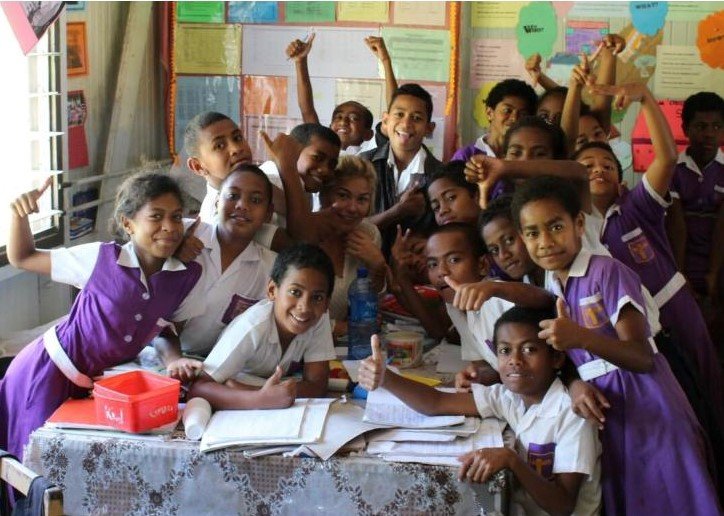
Education in Fiji is taken seriously – primary school enrolment is compulsory and the majority of Fijians complete secondary school.
In fact, roughly 94% of Fiji students finish high school, which is an impressive number in any region of the world.
A major reason for this is that education in Fiji is free from ages 6 to 16. While most schools are government-funded, religious organizations also play their part in providing education opportunities for Fijian children and teenagers.
Like most Commonwealth countries, there is no junior high school in Fiji. After primary (or elementary) school is finished, Fijian students go on to high school. They can either do 3 years and leave to pursue a vocational goal or stay on for 2 more years and look towards tertiary education.
English is generally the teaching language, but students also learn Fijian, Hindi and other languages depending on the school.
As you would expect with such a racially diverse country, Fijian schools also represent the country’s multiculturalism. There are schools catering to various faiths, including Catholic, Muslim, Hindi and Chinese schools. Parents have the option of sending their children to private or public schools and big cities such as Suva have recently seen a surge in international schools.
As with many countries, the standard of education and facilities can vary. Urban schools tend to have better equipped and staffed schools, while rural schools can sometimes be lacking in resources. While private education is certainly available, the cost is considerable and the bulk of education in Fiji is through public institutions.
Despite this, the system works. Fijian students have a literacy rate of over 92% and more and more are focused on finishing high school to chase tertiary options.
All students do Math and English, with other subjects including Fijian, Hindu, woodworking, metal work, home economics, social studies, chemistry and physics.
Fijian students learn about the variety of cultures in their society and the history of their country. A strong focus is given to the natural world, with plenty of time spent understanding the unique ecosystem that surrounds them and how to preserve it.
And then there are the sports.
For a country that embraces the outdoors and healthy living, Fiji punches way above its weight in sports. It all begins in schools.
Fijian students enjoy a huge range of sports such as athletics, rugby union, rugby league, netball, hockey, cricket, soccer, swimming and basketball.
Every year up to 140 schools from across the country meet for a huge athletics carnival known as the Coca Cola Games. This is much-anticipated event and is a chance for up-and-coming athletes to make a name for themselves. Many students who perform well in these games go on to adult sporting careers in the big sports such as rugby union, rugby league, netball and hockey.
If students wish to complete high school and enter a university, their options are becoming better and better. Education in Fiji has seen tremendous growth in the number and quality of universities and vocational colleges.
The University of South Pacific is the most well-know tertiary institution in the South Pacific region. There are also several agricultural, technical and medical schools now offering Fijian students courses that are recognized internationally.
The key to the future of education in Fiji lies in investment from both local and overseas governments. Fiji already attracts students from other South Pacific nations and is fast becoming an educational center in its own right.
Finally, from all the team at FijiDream – Happy 2023!
We wish you a healthy and prosperous new year and thank you as always for your continued support.